There’s a moment most growing businesses hit.
It usually sounds like this:
“Wait… where does that live again?”
“Is that in the CRM?”
“No, I think that’s in the project tool.”
“Check Slack.”
“Maybe it’s in the shared drive?”
And just like that, 15 minutes disappears.
Now multiply that across your team. Across every day. Across an entire year.
The Real Cost of the “Average” Tech Stack
For most SMBs, the typical stack looks something like this:
-
A project management tool
-
An email marketing platform
-
A comms & collaboration app
-
A CRM
-
File storage & documentation software
On their own? Great tools.
Together? Expensive, disconnected, and often redundant.
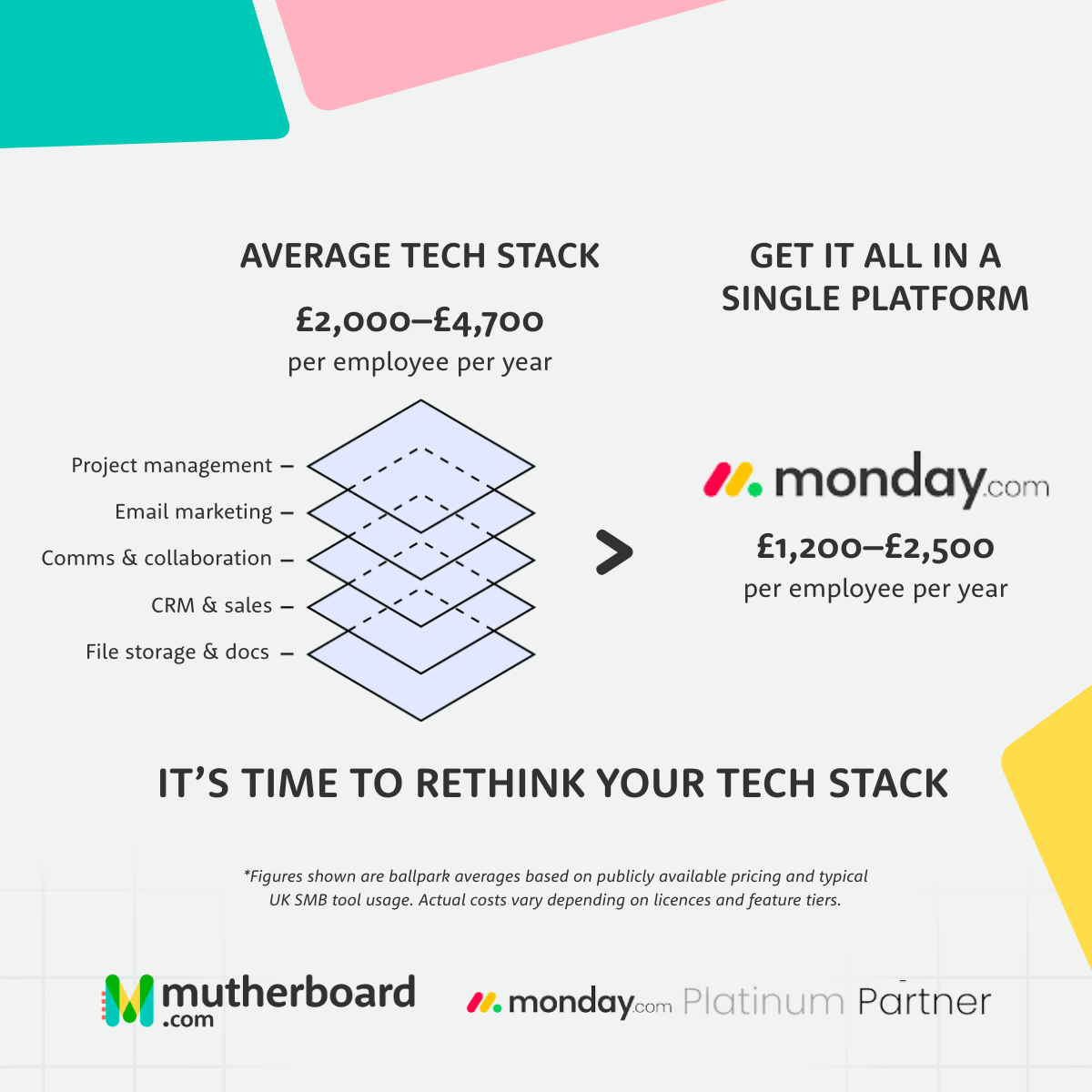
Based on publicly available pricing and typical UK SMB usage, the average tech stack costs between £2,000–£4,700 per employee per year.
That’s before you factor in:
-
Admin time
-
Duplicate data entry
-
Manual reporting
-
Integration gaps
-
Human error
And here’s the kicker: most teams still don’t have full visibility.
You’re paying for tools.
But you’re not necessarily getting clarity.
The Hidden Cost: Operational Drag
The bigger issue isn’t just budget — it’s friction.
When tools don’t talk to each other, people become the integration layer.
That looks like:
-
Copying data from one system to another
-
Manually updating dashboards
-
Guessing team capacity
-
Chasing status updates
-
Exporting spreadsheets to “make sense of it all”
It’s slow.
It’s reactive.
And it’s exhausting.
We see it all the time: brilliant teams stuck doing admin gymnastics because their systems weren’t designed to work together.
What Happens When You Consolidate
When you bring your core operations into a single, connected platform, three things shift immediately:
1. Visibility Improves
Leadership can see pipeline, workload, and delivery in one place.
No more stitching together reports from five different systems.
2. Automation Becomes Powerful (Not Patchwork)
Instead of layering tools with half-connected zaps, workflows live inside the same ecosystem.
Cleaner triggers. Fewer errors. Better data integrity.
3. Teams Stop Context Switching
Less tab-hopping.
Less “where is that?”
More doing.
Platforms like monday.com (especially when implemented properly) can often cover project management, CRM, documentation workflows, reporting, and automation in one environment — typically costing £1,200–£2,500 per employee per year, depending on tier and licensing.
That’s not just a cost saving.
That’s operational leverage.
But Here’s the Important Part
Consolidation doesn’t mean ripping everything out overnight.
It means being intentional.
It means asking:
-
What are we duplicating?
-
Where are we manually bridging gaps?
-
Which tools are critical — and which are just habit?
-
Are we paying for features we don’t use?
The goal isn’t fewer tools for the sake of it.
The goal is smarter architecture.
Tech Should Reduce Chaos — Not Create It
We didn’t build Mutherboard because tech is cool.
We built it because work was chaotic.
We’ve seen what happens when:
-
Tools don’t talk
-
Capacity is guessed
-
Data is scattered
-
Reporting is reactive
And we’ve seen what happens when it’s fixed.
Clarity.
Control.
Confidence.
Your systems should feel like a control centre — not a scavenger hunt.
If your tech stack feels heavier than it should… it probably is.
It might be time to rethink it.